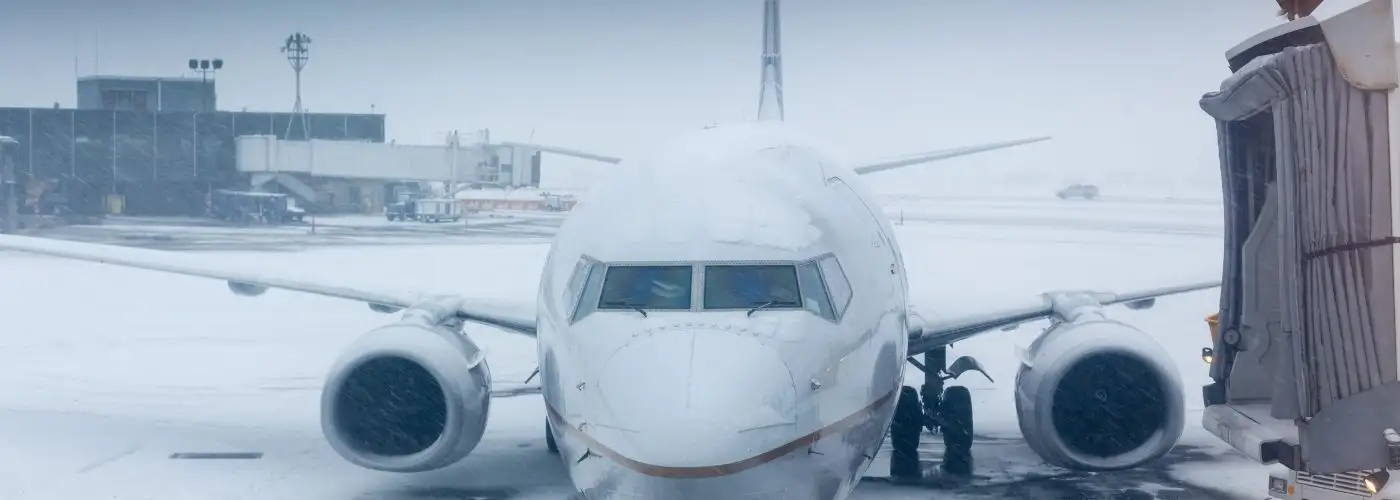
Has it snowed at your home airport yet? It could soon. And while everyone knows that flights generally face more delays and cancellations in winter than in summer, mainly because winter weather can wreak havoc on schedules and plans, not everyone knows just how much travel insurance can offset the financial risk of those winter problems—at least partially.
Here are the common winter travel nightmares that insurance could help you escape, and the buying rules to make sure you’ll be covered or compensated.
Winter Flight Nightmare #1: Missing the Plane
Your biggest financial risk in terms of winter travel is missing your plane due to weather problems getting to the airport—problems that the airline isn’t experiencing. In this case, you risk forfeiting the entire value of nonrefundable ticket, or at least facing a stiff ticket change fee to retain some of the value toward a future ticket. Although some airlines give late arrivals a little slack, if you miss the check-in time you’re likely to be out a good bit of money. And you face the prospect of paying a stiff, last-minute fare for a replacement ticket.
Almost all trip-cancellation policies cover you for missing a plane if you, a traveling companion, or close family member gets sick or suffers an accident before departure time. Some policies cover the risk of late arrival at the airport, but they often specify the conditions: a highway accident, bridge closure, or something else beyond your control. Typically, they don’t cover you if you just oversleep.
Winter Flight Nightmare #2: Flight Canceled
When an airline cancels a flight, it normally arranges a seat on its next available flight, allows you to rebook a new flight (or flights, if you’re on a connecting itinerary) of your choice with no change in fare—or it offers a complete refund, even on a “nonrefundable” ticket. These days, airlines are much more proactive about weather delays than they used to be, and they often cancel flights and arrange alternatives several days in advance of a predicted major weather problem. So you should have some leeway.
What airlines typically don’t do in a weather problem is book you on another airline, even if you bought their travel insurance. If you find a flight on another line that gets you to your destination before the original line can, all you can do is get a refund and try to book a new ticket, which will almost always be a much higher fare. Your financial risk is small on an ordinary flight itinerary. It becomes large, however, if a cancellation makes you miss a connecting flight on another airline, booked on a separate ticket. Here, the second airline treats you as a no-show—which is why you should never book connecting legs on separate airlines.
Winter Flight Nightmare #3: Delays
The risks arising from an extended delay depend on your response to the delay. If you want to abort the entire trip, the airline will usually offer the same options as in a cancellation: rebooking or refund. But you may have to wait for up to 12 hours before the refund/rebook offer becomes effective.
Typically in delays due to weather, airlines do not offer any “amenities” to passengers—meal or hotel vouchers and such—that they often do in delays caused by the airline. Many bundled travel insurance policies offer payments up to $200 a day covering delay-related expenses, along with allowances for delayed baggage delivery. A few premium credit cards also offer similar, but more limited delay benefits.
The Insurance Buying Rules
No matter what sort of travel insurance you’re considering, when you buy travel insurance, you need to follow six basic rules:
Make sure that whatever contingency worries you is a covered reason. Travel insurance is “named peril” insurance: If your basis for a claim is not specifically named as a “covered reason” in the policy, the policy does not cover it. And “cancel for any reason” policies usually cut off “any reason” cancellation 48 hours before departure.
- Don’t wait until bad weather hits. Travel insurance applies only to “unforeseen” contingencies. A policy won’t cover you for weather problems if you buy it after a major winter storm has been specifically forecast and named. If you’re worried about weather problems, buy the policy in advance of any known or anticipated problem.
- Waive pre-existing conditions exceptions. The number one reason claims are denied is pre-existing medical conditions, but most policies waive the exclusion of those conditions if you buy the policy within a short time period—typically a week or two—after you make your first payment on your trip. Even so, you must be physically able to travel at the time you buy the policy.
- Don’t cheap out by failing to purchase as much coverage as much as you might need. Typically, to buy cancellation insurance, you have to insure all of the nonrefundable elements of your trip, not just the airfare portion.
- Don’t buy insurance that duplicates coverages you already get, or payments you can recover from an airline. Most travel insurance is secondary, meaning it pays you only whatever you can’t first recover from a supplier or some other source. Check and travel credit cards you have for coverage they might already provide.
- Buy from an insurance specialist. The insurance that your airline offers may well not be the best value for you. Instead, buy insurance from an independent travel insurance agency such as Squaremouth or Quotewright, where you can compare specific details of competitive policies from a variety of insurers, and select the one that best suits your risks.
More from SmarterTravel:
- 18 Winter Travel Tips
- The Worst Winter Travel Gear (and What to Pack Instead)
- 3 Ways a Hard Brexit Could Hit Travelers in 2019
Consumer advocate Ed Perkins has been writing about travel for more than three decades. The founding editor of the Consumer Reports Travel Letter, he continues to inform travelers and fight consumer abuses every day at SmarterTravel.
We hand-pick everything we recommend and select items through testing and reviews. Some products are sent to us free of charge with no incentive to offer a favorable review. We offer our unbiased opinions and do not accept compensation to review products. All items are in stock and prices are accurate at the time of publication. If you buy something through our links, we may earn a commission.
Top Fares From



Today's Top Travel Deals
Brought to you by ShermansTravel
France: 8-Night Paris, Avignon & Nice...
Infinity Worldwide Vacations
 vacation
$2880+
vacation
$2880+
Poconos: 3 Nts in Garden of...
ResortsAndLodges.com
 hotel
$305+
hotel
$305+
7-Nt Canada & New England Cruise,...
Princess Cruises
 cruise
$839+
cruise
$839+