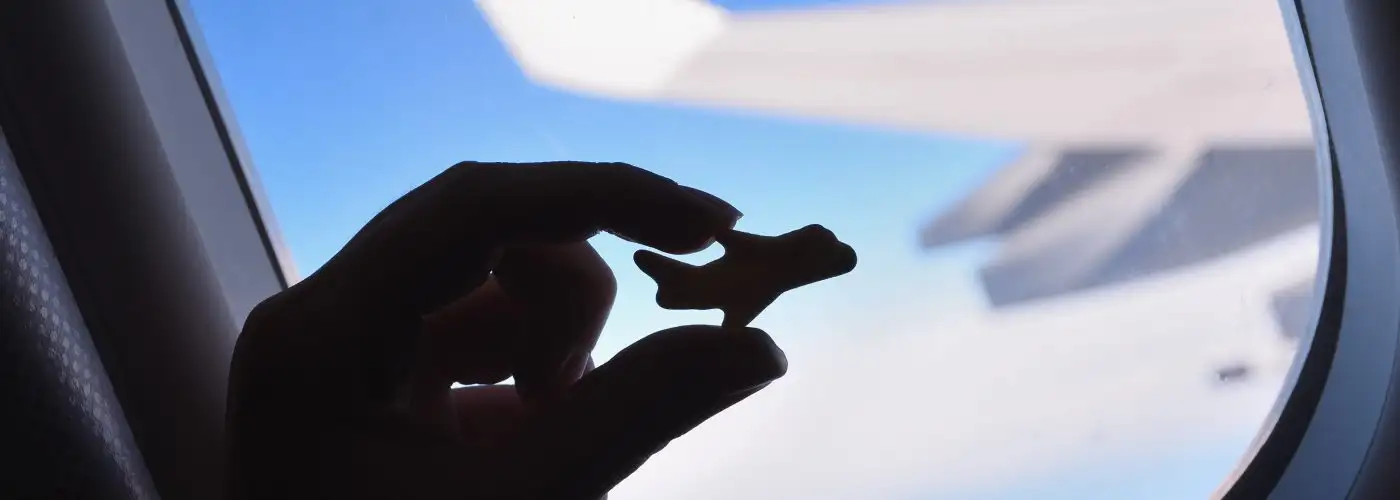
Even if you’re a frequent flyer, we bet you’ve never heard these air travel secrets before. You’ll want to know them before your next flight.
Air Travel Secret #1: Airlines Lie About Flight Times
Ever been on a flight that’s listed on your itinerary as two hours long, yet when the pilot is about to take off, she announces that the flying time will be an hour and a half? Padding flight time estimates is an increasingly common tactic that airlines use to improve their on-time arrival statistics—that way, even if they’re late taking off, they may still technically be on-time when they land.
The Telegraph and aviation analyst OAG recently conducted a study which found that, “over the last couple of decades, despite new technology, scheduled flight times—ie. how long an airline estimates it will take to complete a journey—have actually increased by as much as 50 percent”.
Air Travel Secret #2: There Are Almost 10,000 Planes in the Sky Right Now
According to the flight tracking website FlightAware, an average of 9,728 planes are in the sky at any one time (click here to see a live map of all flights). Want to travel when it’s less crowded? FlightAware reported that New Year’s Day only has an average of 3,354 flights in the air at one time.
Air Travel Secret #3: Airlines Don’t Have to Track Planes in Real Time
Ever wonder how entire commercial jets can go missing for years, like Malaysia Airlines Flight MH370? Following that accident, the United Nation’s aviation agency announced new regulations that would require airlines to track their planes every 15 minutes, as well as equip all aircraft to be equipped with an automated tracking device that will transmit the location every minute during distress. These regulations don’t go into effect until November of 2018, with the final stages being implemented in 2021.
Air Travel Secret #4: That’s Not Duct Tape Holding Your Plane Together
It can be alarming to look out your window seat and see what appears to be duct tape on the wing, but don’t worry, that’s not what’s holding your plane together. It’s a high-tech adhesive (approved by the FAA) that will stay in place even at speeds of over 500 mph, and is rightfully nicknamed Speed Tape. It’s used as a temporary fix for smaller repairs that need to be completed quickly, so don’t worry, you won’t see a roll of tape securing the engine to your plane.
Air Travel Secret #5: The World’s Shortest Commercial Flight Is a Minute Long
Don’t expect drinks service on the jaunt from Westray to Papa Westray (part of the Orkney Islands in Scotland), which is the world’s shortest scheduled passenger flight. The flight, operated by Loganair, takes just about one minute, although it has been flown in as little as 53 seconds.
Air Travel Secret #6: Airplane Air Is as Dry as a Desert
Ever wonder why you’re so dehydrated when you get off of a long flight? The humidity in aircraft cabins is only around 20 percent, which is less than in the Sahara Desert’s average of around 25 percent. This is because the air outside the plane has minimal humidity at 30,000 feet, so it has to be added back in.
Air Travel Secret #7: Air Traffic Controllers Are Highly Paid
The people on the ground responsible for making sure that planes don’t crash into each other are paid accordingly, with a median yearly salary of over $124,000. It makes sense—this job requires intense concentration while working in a semi-dark room (no slacking off on the internet allowed here), as well as weekend, night, and holiday shifts. Air traffic control is such a stressful job that employees are required to retire at 56.
More from SmarterTravel:
- 8 Ways Basic Economy Fares Can Ruin Your Trip
- 5 Ways to Survive a Flight in Basic Economy
- 11 Must-Haves for Your Carry-on Bag
Caroline Morse Teel would love to hear your air travel secrets. Follow her on Instagram @TravelWithCaroline.
We hand-pick everything we recommend and select items through testing and reviews. Some products are sent to us free of charge with no incentive to offer a favorable review. We offer our unbiased opinions and do not accept compensation to review products. All items are in stock and prices are accurate at the time of publication. If you buy something through our links, we may earn a commission.
Top Fares From
Today's Top Travel Deals
Brought to you by ShermansTravel
France: 8-Night Paris, Avignon & Nice...
Infinity Worldwide Vacations
 vacation
$2880+
vacation
$2880+
Poconos: 3 Nts in Garden of...
ResortsAndLodges.com
 hotel
$305+
hotel
$305+
7-Nt Canada & New England Cruise,...
Princess Cruises
 cruise
$839+
cruise
$839+