
As with the best flight booking sites, there’s no shortage of resources available when you need to book a cheap hotel room. From metasearch engines (aggregator) that send you to company sites, to bookable OTAs (online travel agencies), to corporate hotel sites, the options for the best hotel booking sites can be overwhelming. But when doing your search, deciding which hotel booking sites to compare should depend on how often they offer the best hotel deals, and how you prefer to view and filter search results.
The Best Hotel Booking Sites for Comparing Prices
For most travel planning, the best overall strategy is to compare prices from multiple sources including the hotel’s own website, as it will sometimes offer deals not shared with third-party sites, or offer the same rates as third-party sites minus pesky booking fees. Hotels sites will also offer package deals—bundled amenity inclusions and the like—that aren’t shared with third-party sites.
Bottom line: Whether you search with a hotel site on this list or a preferred hotel search engine of your own, always check the hotel’s actual website as well, or call its reservations line, to make sure you really are getting the best hotel deal. Don’t forget to check the cancellation policy as the best hotel booking site is one that has a flexible policy in case your plans change.
If you’re trying to figure out how best to search for cheap hotels: First, scan this quick list of the best hotel search sites, in no particular order. Then, scroll down to read in-depth summaries of each or click to jump to a particular site.
- Booking.com
- Kayak
- Priceline
- BookingBuddy
- Hotels.com
- HotelsCombined
- Expedia (which owns Travelocity and Orbitz)
- Agoda
- Tripadvisor
- Trivago
- Hotwire
- Mr. & Mrs. Smith
No list of the best hotel booking sites is exhaustive, but these 14 represent a combination of great crowd favorites mixed with some newer, similarly performing hotel search options that you might not know about.
All of them fared well in tests: Prices for the same dates and destinations were fairly consistent from site to site, but the volatility of results may vary based on your destination, how far in advance you’re looking for the best hotel deals, and the time of year you visit (i.e., high season vs. low).
With that in mind, here are the best hotel booking sites to compare prices with for your next trip, plus the best feature of each one.
Booking.com

| Best feature: The variety of property types and blended search results. Booking.com is a good hotel search site for a wide range of budgets. |
- Insofar as keeping your options open goes, Booking.com returns the most eclectic search results by far, with a healthy mix of hotels, motels, b&bs, apartments, and hostels. But whether this is a good or bad thing depends entirely on your preferences. If you’re not a fan of hostels, for example, hotel search results like this mean that you have to filter them out, creating an extra step that other hotel booking sites don’t require. That said, Booking.com offers something for everyone.
- Its handy hotel search engine displays the total cost up front (except taxes) which is helpful when comparing cheap hotel rates; being able to see the total hotel cost up front helps you quickly determine which hotels actually fit into your budget.
- Its filtering options are extensive, from price, cancellation policy, sustainability, specific neighborhood for that city, fun things to do nearby, amenities, room accessibility and much, much more. With this filter feature, you will be able to find exactly the kind of accommodations you want.
Kayak

| Best feature: Clean, easy-to-use interface. It’s also one of the best hotel apps you can download onto your phone. |
- Like its flight search, Kayak‘s hotel search offers a clean, easy-to-use interface with many available filters.
- Shows other hotel booking sites’ rates so you can compare them all in one place. But the first hotel price result is often higher than better rates farther down the list, unless you specifically filter by price. Kayak’s hotel search results are automatically sorted by the vague factor of what’s “Recommended,” which is true of many hotel booking sites. Often, higher rates populate first while scrolling results, and sometimes that lead price is much higher than other comparable hotel options. Be sure to change sorting to price, so you can find the best deal.
- It’s search calendar is color coded to show you cheap, average, and high prices, which comes in handy if price is your number one priority when booking a hotel.
- If you are someone who likes to book by ratings, each hotel page on Kayak has the rating in a large box just next to the hotel pictures. It’s easy to find, and may help you to make your decision quickly.
Priceline

| Best feature: The “Express Deal” feature is a major differentiator from other discount hotel sites. It’s a big plus if you’re looking for the best hotel deals and are open to not knowing exactly which hotel you’re booking. |
- Priceline has one of the more visually appealing design layouts of the major hotel search engines, and is definitely among the easiest hotel sites to navigate. None of these hotel search sites is dramatically different from the others in terms of rates or price comparison, so usability can go a long way toward improving the experience of searching for the best hotel prices.
- Unsurprisingly, Priceline’s prices are on par with the other online travel agencies (OTAs), and its results are largely focused on downtowns and tourist-friendly areas. A big draw of Priceline is their “Express Deal” option: a flash deal that hides the name of the hotel until after you book. While somewhat gimmicky, this hotel search option can offer significant savings.
- The handy map that is featured on each hotel page, which will show you other hotels in the area and the prices. This is particularly useful if you want to stay in the city center, by a specific landmark, or are visiting friends or family and want to be nearby where they live.
BookingBuddy

Editor’s note: BookingBuddy is owned by SmarterTravel Media, SmarterTravel.com’s parent company.
| Best Feature: BookingBuddy lets you compare vacation rentals and hotels at the same time, so you can see which is the better deal in your destination. |
- Compare multiple hotel booking sites with one click to find the cheapest hotel stays on BookingBuddy. This site lets you quickly compare prices of as many other search sites (like VRBO or Trivago) as you want, without having to do a bunch of different searches. Simply select which hotel/vacation rental search sites you want to compare, and BookingBuddy opens up a new tab with your selected hotel stay dates and destination already filled in.
- You can sign up for an alert for when prices drop. If you are in no rush to book, you just may find a super deal if you sign up for an alert!
- Like other sites on this list, BookingBuddy pulls in and displays the best deals from various booking sites and OTAs on their own search results page. However, BookingBuddy also lets travelers directly compare entire search result pages across multiple sites, allowing them to toggle between the pages from a lefthand navigation menu.
Hotels.com

| Best feature: Hotels.com offers more hotel search filters than most travelers could ever use, but it’s nice to have those options. You can filter hotel listings by everything from breakfast included, attractions, services, pool availability, distance to city center, guest ratings, and much, much more, insuring you are getting exactly the kind of room you want. |
- Hotels.com helps you find the best hotel deals via tons of filters that let you narrow down your search. Its initial results tend to show a healthy balance of lower- and upper-end hotels, mostly in or around city centers. That’s what most travelers want in a hotel search engine: a robust, easily refined list of well-located options. Prices were on par with other OTAs.
- Like many cheap hotel websites these days, Hotels.com includes lots of non-hotel properties too, including condo hotels, guesthouses, and bed and breakfasts.
HotelsCombined
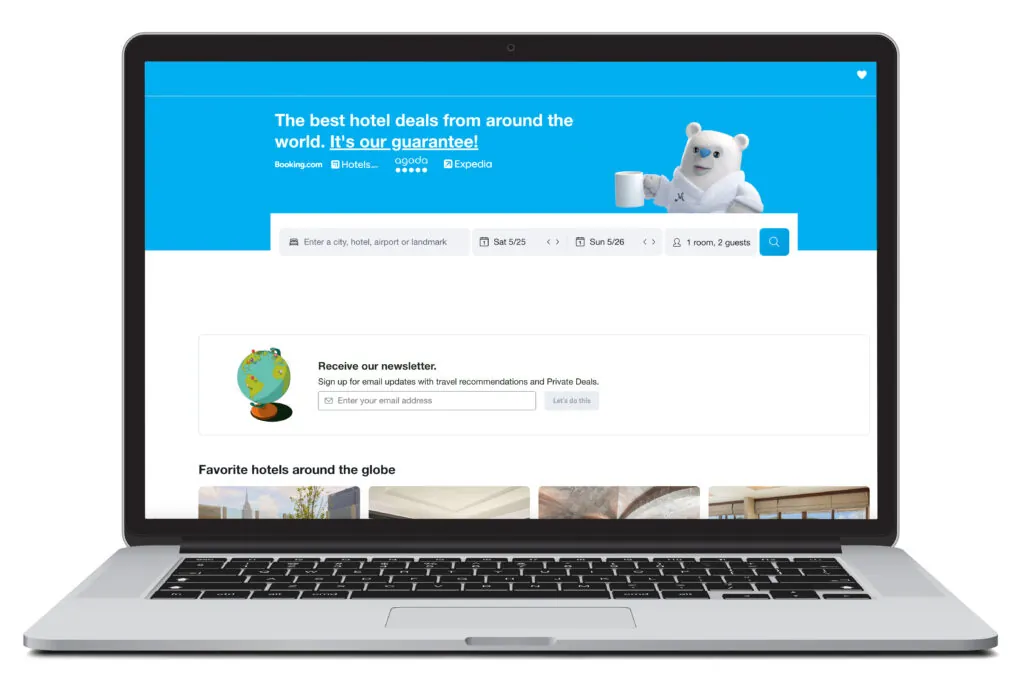
| Best feature: The sheer volume of results makes this a good place to start your hotel search, but do be sure to scrutinize prices and options when you land on the actual hotel booking site to make sure they match. |
- HotelsCombined is a meta search tool that searches a wide range of sources to find the best hotel deals, including OTAs, as well as the hotels’ own sites.
- You can also toggle between nightly base price, nightly price plus taxes/fees, or total stay plus taxes/fees. There is no option to display the total price of the stay without taxes/fees.
- Easily see if your travel dates are during peak travel times with their color coded calendar showing you if your dates have “Cheaper, Average,” or “Higher” prices.
Expedia, Travelocity, and Orbitz

| Best feature: Dependability. Expedia, Travelocity, and Orbitz are the Honda Accords of hotel booking sites. You’ll reliably find what you need, at the best prices, and with minimal hassle. Just be sure to compare prices to a hotel booking site that’s outside the Expedia family. |
- Short of the color scheme and fonts, you’d be hard pressed to find much difference between these three legacy hotel booking sites. Expedia, Travelocity, and Orbitz are all owned by Expedia Inc., and all three use the same layout, with a few minor tweaks. Interestingly, the hotel search results do vary slightly.
- The top hotel result for each test search was the same on Orbitz and Travelocity, but the order of the list of hotels below it varied. Interestingly the top search result on Expedia frequently differed, although the top result from the other two sites was typically still high on the list. Prices, of course, were the same, since they’re all powered by Expedia. These perfectly fine hotel search engines are not all that different from Hotels.com.
- Keep an eye on these hotel sites’ deals and limited-time offers, which is when any of these three hotel search engines are more likely to substantially beat their competition.
- With these sites, you can easily add a flight or car rentals to your accommodation booking, making for easy one-stop-shopping.
Agoda

| Best feature: A good selection of well-located places to stay, with some of the best hotel prices around. |
- Originating as a hotel booking site with a focus on Asia and later expanding to offer U.S. properties, Agoda delivers a hotel search experience that matches some of the best hotel sites on this list.
- There are even instances when Agoda had better hotel deals than its competition, including one hotel search result in which the total booking cost was more than $200 less than the same hotel on Priceline (with a coupon code). Don’t expect that sort of result every time, but it shows that Agoda, like all the rest of these hotel booking sites, is well worth checking for the best hotel deals.
Tripadvisor

| Best feature: Tripadvisor gives users the unique ability to simultaneously research hotel reviews and compare prices from hotel booking sites. |
- Like HotelsCombined, Tripadvisor‘s hotel search displays some of the very best hotel deals from a range of sites. The tool is built right into Tripadvisor’s general search function, letting you browse the site’s vast library of reviews, then begin your hotel booking seamlessly. The initial list of hotel search results is sorted by “best value” and shows the source of the given price, so that you know where (off Tripadvisor) your hotel booking is going to happen.
- Tripadvisor searches most of the major hotel booking sites, as well as some lesser-known ones; when applicable, it also includes the hotel’s own website. You can also book directly with Tripadvisor.
- Sort your search by traveler ranking, so you can see the hotels travelers just like you prefer. Guest reviews often include pictures of hotel rooms taken by the guests themselves, not clouded over by staging, so you can see what the rooms actually look like before you book.
Trivago

| Best feature: Trivago’s mix of hotel sites searched is strong, and includes hotel sites that travelers may not have otherwise known about, which could result in finding some of the best hotel deals out there. |
- Another aggregate hotel booking site, Trivago did surface that low price coupon found on Agoda. However, it did not lead with that price, choosing instead to prominently display a higher price from Booking.com in large, green text. Odd. The lower-priced Agoda deal was listed second in the hotel search results, displayed in small gray text along with several others. In fact, Trivago found multiple hotel deals lower than that Booking.com price, but none received top billing for some reason. This happened in several other cases too, where the lead price ended up higher than best hotel prices that Trivago could find.
- The good thing about conducting a hotel search on Trivago is that Trivago searches several lesser-known hotel booking sites, including Agoda, in addition to the usual suspects like Expedia, Priceline, and Booking.com. But travelers should take a close look at Trivago’s hotel search results to make sure that Trivago isn’t hiding a better deal farther down the list.
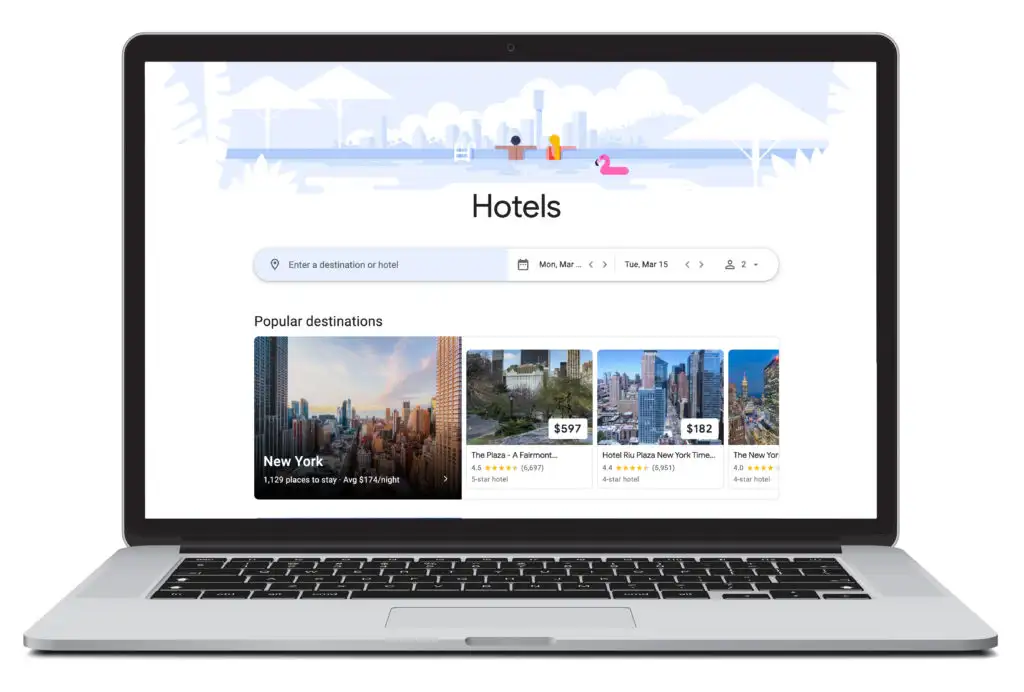
| Best feature: Location is usually pretty important when choosing a hotel, and Google Maps integration—with satellite and street view—allows you to easily factor that into your hotel search. |
- Google’s hotel search engine works by simply entering “hotels in (insert city here)” right on Google.com. (You can also go straight to the Google Hotels page.) This feature is integrated into Google Maps, which makes it very different from any of the other hotel booking sites listed above. On Google, hotel locations are marked by prices on a map, rather than by name or any other identifying characteristic.
- From there, Google’s hotel search tool is fairly price-forward, which is what metasearch should be. Clicking on a price displays the hotel’s name, features, and booking options. Overall, it’s no surprise that Google offers a powerful, no-frills hotel search engine for travelers who don’t want all the hard-sell aspects of cheap hotel sites and more commercial hotel search engines. (And yes, Google did surface that low-with-coupon hotel deal from Agoda.)
Hotwire

| Best feature: Hot Rates that will put you up in a comfortable, if not four-star hotel, and for a two-star price. |
- One of the best hotel booking sites for last minute deals and “Hot Rates,” which hide the hotel name in order to give you a better rate (similar to Priceline’s Express Deals), Hotwire is a great option if you don’t mind a limited-details final booking; and you probably don’t if it’s short notice.
- Hotwire’s Hot Rates descriptions feature so many details about the property, as well as a pretty narrow location radius, that you can sometimes figure out the hotel you’ll be booked in, although it’s still somewhat of a gamble. Hotwire is also partnered with reliable global hotel brands like Kimpton and Hyatt, so you can be more confident that you won’t end up with a ramshackle property.
- The savings vary depending on the destination, but Hot Rates are consistently much more competitive than the standard Hotwire rates, which aren’t always the best price compared to other hotel booking sites. The main qualm that most customers have with Hotwire is their “24/7 support,” which apparently can be pretty unhelpful despite always being available to you.
Mr. & Mrs. Smith

| Best Feature: Mr. & Mrs. Smith serves boutique hotels throughout the world, so your search will result in more unique accommodations. |
- Their price match feature goes above and beyond the usual. If you find a lower price elsewhere, they will not only match it, but you will also receive a $50 voucher.
- You must become a member to book through Mr. & Mrs. Smith, however, entry-level membership is free. Members receive “Smith Extras” upon arrival to their hotel—anything from a bottle of champagne to a spa service!
- Hotels must be invited to join this website, as they are carefully vetted by “undercover tastemakers” before being added to the site.
Which Hotel Booking Site Is Best for Me?
Consider what type of trip you are taking. If you are open to the type of place you want to stay at, then consider a site with more diverse options. If you are torn between a hotel or vacation rental, BookingBuddy is the site for you, as it will search for both to help you make your decision. If you rely heavily on peer reviews, then go with TripAdvisor. Check our best features of each site above to decide which site is best for you to make your hotel reservation. For
What is the Difference Between an Online Travel Agency (OTA) and Metasearch Engine?
An OTA allows you to book directly through them, and does not send you outside of their site to make your booking. a Metasearch Engine (also known as an aggregator) searches multiple sites including OTA’s, and will send you to a site outside of the aggregator to finalize your booking.
Is It Cheaper to Book Directly with a Hotel or With a Hotel Booking Site?
It might be cheaper to book directly with a hotel, but this option really only makes sense if you already have a hotel you love and you want to book. Otherwise, the fastest, cheapest way to book a hotel is going to be by using one of the hotel booking websites. You will waste a lot of time calling hotels to see if you can get a better deal, and who has time for that these days?!
When Should I Book My Hotel?
This really depends on your flexibility. If all you want is the best deal, and you aren’t picky about where the hotel is, waiting until the last minute (one to two days before you travel) could probably get you the best deal on your hotel. But, you might not want to risk that—I know I wouldn’t when planning a vacation! If you are booking for travel during peak times, book early so you don’t end up far away from where all of the action is, as hotels can book up quickly, especially during school vacation times.
Bottom Line
What is the Best Hotel Booking Website?
These days, we are inundated with choices, including the number of accommodation booking websites there are out there. These sites should all make your booking easier, but some will make it even easier. Our clear winner is HotelsCombined.com. It’s easy to read, you can choose from hotels and rentals, and its ability to search hotel sites gives it the edge over other sites. Booking.com is solid runner-up, as they appear to have the other sites beat as far as the volume of hotels goes.
Editor’s note: This story was originally published in 2016. It has been updated to reflect the most current information. All of the products featured in this story were hand-selected by our travel editors. Some of the links featured in this story are affiliate links, and SmarterTravel may collect a commission (at no cost to you) if you shop through them. As an Amazon Associate, we earn from qualifying purchases.
You Might Also Like:
• Everything You Need to Know About the 24-Hour Rule• 8 Genius Ways to Preserve Your Phone’s Battery Life While Traveling
• The Worst Days to Visit NYC: Surprising Dates to Avoid
• Up to 25% Off Train Travel with Amtrak’s Fall Flash Sale
• The Worst Seats on a Plane (and How to Avoid Them)
We hand-pick everything we recommend and select items through testing and reviews. Some products are sent to us free of charge with no incentive to offer a favorable review. We offer our unbiased opinions and do not accept compensation to review products. All items are in stock and prices are accurate at the time of publication. If you buy something through our links, we may earn a commission.
Top Fares From




Today's Top Travel Deals
Brought to you by ShermansTravel
12-Night Peru Escorted Tour, Incl. Sacred...
Wingbuddy
 vacation
$2198+
vacation
$2198+
Amsterdam to Copenhagen: Luxe, 18-Night Northern...
Regent Seven Seas Cruises
 cruise
$12399+
cruise
$12399+
Ohio: Daily Car Rentals from Cincinnati
85OFF.com
 Car Rental
$19+
Car Rental
$19+