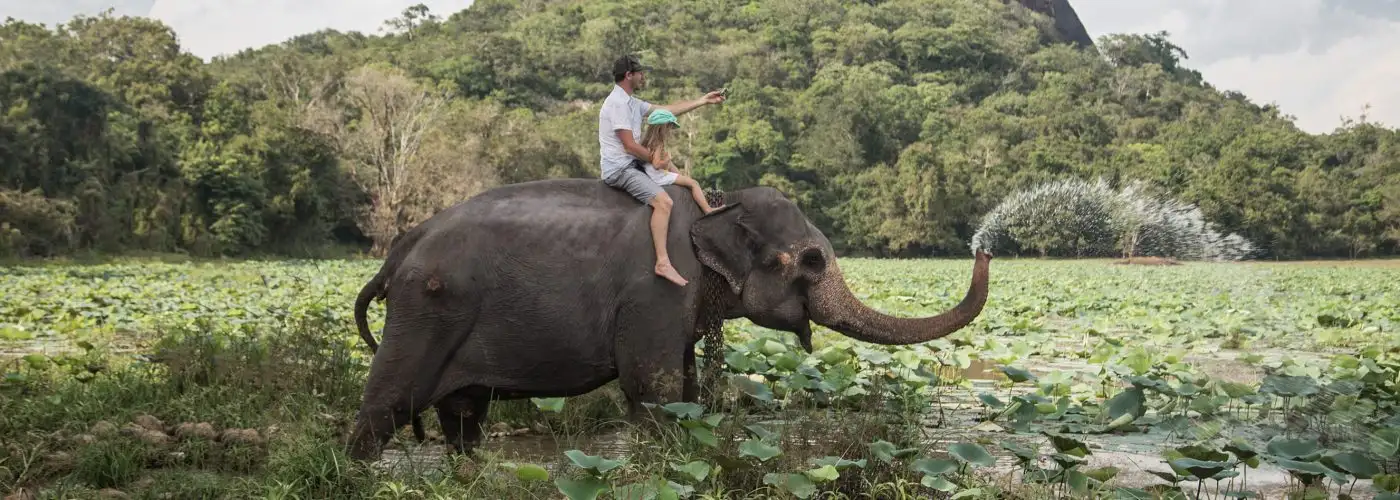
Travel teaches us the world is an ever-changing place. We venture around the globe to see bodies of water that were once glaciers, ruins that have been strained by conflict and time, and cities that sprang up mere decades ago. But in many places, one truth of travel has remained sadly unchanged: Animals are abused to fuel tourism, and travelers eagerly participate.
If you’ve ever considered riding an elephant, swimming with dolphins, posing next to a chained tiger, or watching a snake charmer, you’ve come closer than you may realize to animal cruelty. Here’s how.
Wild vs. Captured
I recently visited Sri Lanka, an island home to 5,800 wild Asian elephants and 340 tamed ones, and saw the effects tourists can have on wildlife. Sri Lankan elephants were classified as endangered in the 1980s after deforestation and poaching halved the population. I’ve always loved learning about these emotional, matriarchal, intelligent creatures, and my highest hope was to see one in the wild.
It was a dream come true to see several grazing in protected Yala National Park, but most of my elephant memories from the trip are the experiences that gave me pangs of discomfort at almost every tourist attraction. Elephants seemed to be everywhere, but they were chained up—alone and swaying back and forth with psychosis, waiting to be paraded in costume for temple ceremonies, or to endlessly carry giddy groups of tourists. Suddenly I couldn’t bear to look at the animals I’d been so excited to see.
International non-profits like World Animal Protection have determined that treks and captivity have a dangerous impact on these animals, and it’s not just elephants that suffer from tourism. Drugged tigers in “sanctuaries,” “charmed” snakes with their mouths sewn shut, street-performing monkeys, and wild orcas in captivity have long drawn crowds.
How It’s Still Happening
The biggest problem with wildlife attractions seems to be that people are simply unaware of the abuse they’re enabling. Amidst the excitement of getting in touch with beautiful animals, travelers aren’t thinking critically about the industry behind the pastime.
About 80 percent of people participating in wildlife attractions like these don’t think they’re harmful to the animals, the University of Oxford’s Wildlife Conservation Research Unit found last year. The study was the first one to analyze wildlife tourism, and the results signal that there’s work still to be done to educate tourists and government officials about the proven implications of animal attractions.
Some strides have been made. Thailand officials are investigating the country’s famed “tiger temples,” Jakarta has cracked down on monkey shows, Sea World recently announced an end to orca breeding and capture, and dozens of travel companies have pledged not to participate in elephant treks or shows.
Still, these efforts make up just a small part of global tourism. Seeing the persistent success of animal attractions firsthand in Sri Lanka made me realize just how far we have to go when it comes to these cruel attractions—but awareness is on the rise. Perhaps one day I’ll return to a different Sri Lanka, with more wild elephants and fewer animal shows.
Seeing local wildlife on your travels still a priority? Read our eight ways to see wildlife responsibly when you’re on vacation.
More from SmarterTravel:
- Please Do Not Participate in These Cruel Activities on Vacation
- World’s Most Adorable Animals
- Moral Dilemmas: Should You Do These Things While Traveling?
Associate Editor Shannon McMahon writes about all things travel. Follow her on Instagram and Twitter for more insight and adventures.
We hand-pick everything we recommend and select items through testing and reviews. Some products are sent to us free of charge with no incentive to offer a favorable review. We offer our unbiased opinions and do not accept compensation to review products. All items are in stock and prices are accurate at the time of publication. If you buy something through our links, we may earn a commission.
Top Fares From




Today's Top Travel Deals
Brought to you by ShermansTravel
France: 8-Night Paris, Avignon & Nice...
Infinity Worldwide Vacations
 vacation
$2880+
vacation
$2880+
Poconos: 3 Nts in Garden of...
ResortsAndLodges.com
 hotel
$305+
hotel
$305+
7-Nt Canada & New England Cruise,...
Princess Cruises
 cruise
$839+
cruise
$839+